Introduction
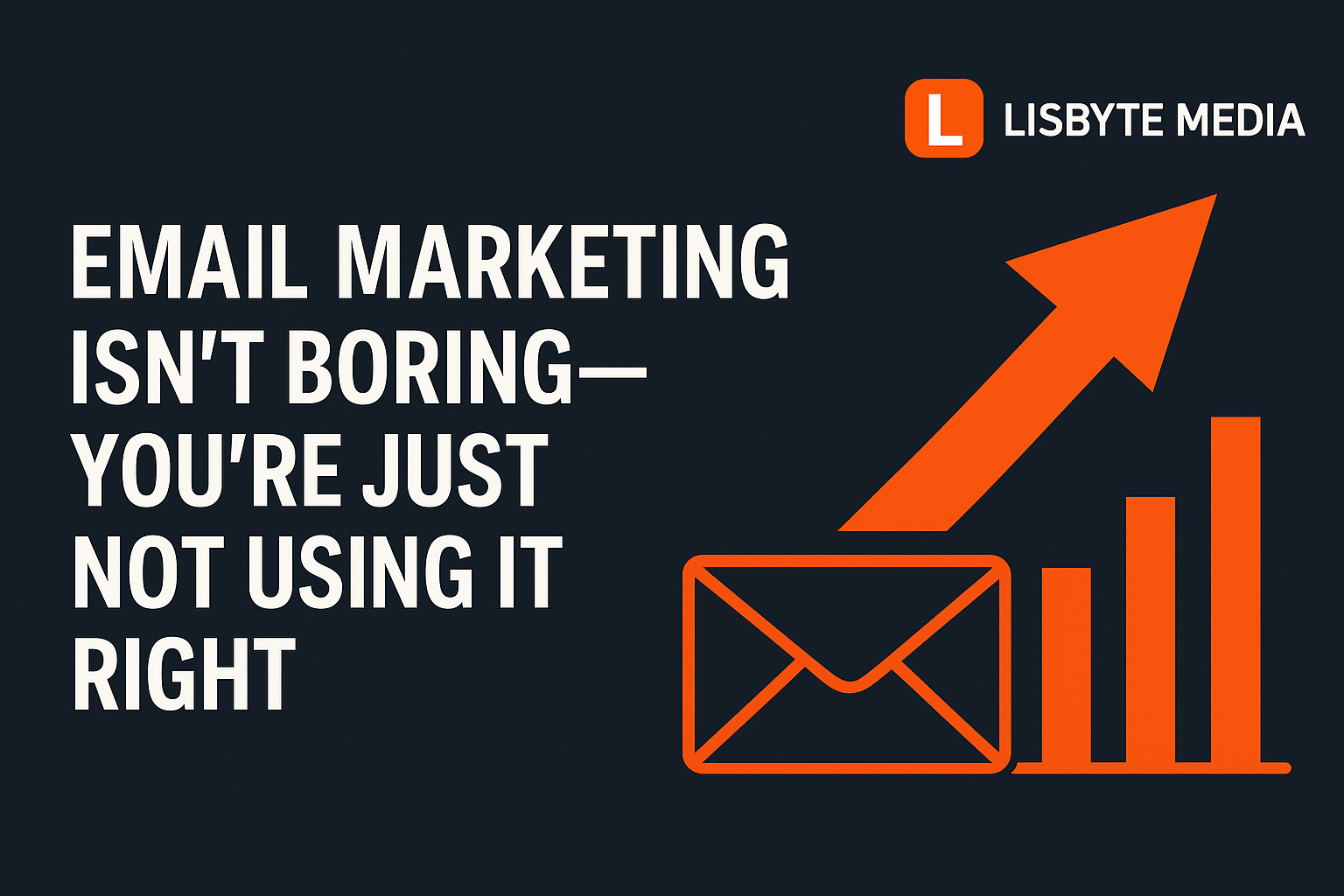
Email marketing has survived every digital revolution. From the dawn of social media to the dominance of AI-driven advertising, email has quietly remained the highest-performing channel in marketing history. Yet, many brands treat it like an afterthought—sending generic newsletters, poorly timed promotions, or uninspired copy that lands directly in spam folders.
The problem isn’t the medium—it’s the execution.
At Lisbyte Media, we’ve audited and rebuilt dozens of underperforming email programs. In every case, the issue wasn’t lack of opportunity—it was lack of strategy. When done right, email isn’t boring; it’s a brand’s most consistent, controllable, and profitable relationship channel.
This article unpacks why email still matters, what most brands get wrong, and how to transform your email marketing into a scalable growth engine.
💬Section 1: Why Email Still Wins
Despite the rise of social and paid media, email marketing remains a cornerstone of digital strategy. The statistics alone are staggering:
- Over 4.2 billion people use email daily.
- The average ROI for email marketing is $36 for every $1 spent (Data & Marketing Association).
- Email reaches audiences directly—without depending on algorithms or third-party platforms.
1.1. The Direct Line Advantage
Unlike social platforms, where your organic reach can fluctuate overnight, your email list is an owned asset. It’s immune to algorithm changes and platform volatility. When someone subscribes, they’re granting you permission to communicate directly—an advantage that no other channel can replicate.
1.2. Relationship Over Reach
Email’s power lies in its intimacy. It’s the only digital space where your message lands in someone’s personal inbox—a space they check several times a day. When crafted strategically, each message can reinforce trust, guide decision-making, and strengthen brand loyalty.
Email isn’t about broadcasting—it’s about connecting.
1.3. The Misconception Trap
Too many brands approach email as a “blast” channel—pushing the same content to everyone. That’s the equivalent of running one billboard for ten different audiences. High-performing brands know better: they segment, personalize, and contextualize. That’s where the difference between noise and conversion begins.
💬Section 2: The Strategy Behind Great Emails
Great email marketing isn’t built on frequency—it’s built on relevance. A sophisticated email strategy aligns content, timing, and personalization to the customer’s intent and position in the funnel.
2.1. Segmentation: The Foundation of Relevance
Every subscriber is unique. A first-time visitor shouldn’t receive the same message as a returning customer or a dormant lead. Strategic segmentation divides your audience based on:
- Demographics (age, location, gender)
- Behavior (pages visited, links clicked, products viewed)
- Lifecycle stage (lead, prospect, customer, advocate)
- Engagement level (active vs. inactive subscribers)
A segmented approach allows you to tailor messaging and offers with surgical precision—dramatically improving open and conversion rates.
2.2. Journey Mapping: Timing Is Everything
Emails should follow the buyer’s journey, not the marketer’s schedule. That means understanding where the subscriber is and delivering the right message at the right time.
Example journey flow:
- Awareness → Educational content, brand story, social proof.
- Consideration → Product demos, case studies, testimonials.
- Decision → Personalized offer, limited-time discount, or CTA.
Lisbyte Media uses journey-based workflows that trigger messages automatically as users progress through their decision stages. The result: consistent engagement and higher revenue per subscriber.
2.3. Automation That Scales Personalization
Modern email automation tools (like ConvertKit and ActiveCampaign allow brands to send highly personalized emails at scale. By connecting behavior data with automated workflows, you can greet new subscribers, re-engage inactive ones, and nurture leads—all while maintaining a human tone.
Automation doesn’t replace authenticity—it amplifies it.
💬Section 3: What Makes an Email Convert
A well-designed email campaign isn’t just about visuals or branding—it’s about psychology. What drives someone to click? To buy? To engage?
3.1. The Subject Line: The Gatekeeper of Attention
If the subject line fails, nothing else matters. Strong subject lines are:
- Curious – Spark interest without giving away too much.
- Relevant – Match the recipient’s intent or problem.
- Concise – Under 50 characters performs best.
- Personalized – Include name, company, or context where appropriate.
Example:
❌ “Get our newsletter!”
✅ “You’re missing out on 36% more conversions—here’s why.”
3.2. The Body Copy: Value Over Volume
In consulting, clarity wins over cleverness. The same applies to email. Focus on delivering actionable value:
- Lead with empathy: Acknowledge the reader’s pain point.
- Present a solution: Explain how your brand solves it.
- Highlight the benefit: Quantify outcomes where possible.
Use formatting strategically—short paragraphs, bold highlights, and white space guide the eye.
3.3. The Call-to-Action: The Conversion Trigger
Every email needs one clear, unmistakable CTA. Whether it’s to download, book, or buy, the call should be:
- Action-oriented: Use verbs that imply motion (“Get,” “Claim,” “Start,” “Unlock”).
- Visible: Use contrasting colors (Lisbyte’s #E84613 works perfectly).
- Singular: Don’t overwhelm readers with options.
💬Section 4: Automation That Feels Human
One of the biggest misconceptions about automation is that it makes marketing robotic. In reality, the opposite is true—when implemented correctly, automation enhances human connection by ensuring the right message reaches the right person at the right time.
4.1. Welcome Sequences: First Impressions That Convert
The moment someone joins your list is your best opportunity to engage. A high-performing welcome sequence typically includes:
- Welcome Email: Warm introduction and brand story.
- Value Email: Deliver immediate, actionable insight or resource.
- Proof Email: Show a client win, case study, or testimonial.
- Conversion Email: Present a low-friction CTA (like booking a free audit).
4.2. Abandoned Cart Recovery: The Easy Win
Nearly 70% of online shopping carts are abandoned. Well-timed follow-up sequences recover 10–15% of lost revenue. Using Klaviyo or Omnisend you can automate reminders, offer limited-time incentives, and personalize based on the abandoned product.
4.3. Re-engagement Campaigns: Wake the Sleeping List
Every list has dormant subscribers. Reactivate them through re-engagement campaigns featuring surveys, new offers, or “We Miss You” messages. Even a small percentage of revived users can dramatically improve ROI.
4.4. Lead Nurturing Flows: Building Trust Over Time
Lead nurturing isn’t about selling immediately—it’s about providing consistent, relevant value until the subscriber is ready. This could mean sending educational guides, case studies, or success frameworks.
Lisbyte Media builds evergreen nurturing frameworks that adapt over time, ensuring consistent performance across industries.
💬Section 5: Metrics That Matter
Data is what separates performance marketing from guesswork. But too often, marketers track the wrong numbers. Vanity metrics (like open rates alone) tell part of the story—but not the part that drives growth.
5.1. The Core Metrics
- Open Rate: Indicator of subject line effectiveness and deliverability.
- Click-Through Rate (CTR): Measures engagement with your message.
- Conversion Rate: Tracks direct action—purchases, signups, or bookings.
- Unsubscribe Rate: Health check for content relevance.
5.2. Beyond the Basics
For advanced campaigns, track:
- Revenue per Email (RPE) – Measures direct profitability.
- List Growth Rate – Evaluates acquisition efficiency.
- Engagement Over Time – Reveals decay patterns for optimization.
Lisbyte Media employs tools like HubSpot Marketing Hub and SEMrush Email Analytics to centralize data across campaigns, ensuring every insight translates to strategic action.
5.3. Data to Strategy Loop
Measurement is only valuable if it informs strategy. Our optimization framework at Lisbyte Media revolves around three questions:
- What’s working?
- What’s underperforming?
- What will we test next?
By turning insights into action, brands continuously improve performance without guesswork.
Affiliate Recommendations (Strategically Integrated Tools)
| Category | Recommended Tool | Strategic Use |
|---|---|---|
| Email Automation | ConvertKit | Lightweight, creator-friendly automation for small to medium brands. |
| CRM & Nurturing | HubSpot Marketing Hub | Enterprise-grade CRM with full-funnel email automation. |
| E-commerce Email | Klaviyo | Ideal for abandoned cart recovery and purchase-based segmentation. |
| Email Design | Canva Pro | Quick, brand-consistent visual templates for high-performing emails. |
| Campaign Analytics | SEMrush | Integrated keyword + email analytics for data-backed optimization. |
| Workflow Management | ClickUp | Manage campaigns, automation timelines, and performance reviews efficiently. |
💬 Quote from the Founder
“Email isn’t noise—it’s a conversation. We help brands speak clearly, consistently, and profitably.”
— Chuka Okoye, Founder, Lisbyte Media